
Emergency Air Duct Cleaning Near Me: What Salt Lake City Homeowners Should Do First
If smoke, sewage odor, or visible mold is coming from your vents right now, running your HVAC system while you search for a cleaning company is actively spreading the contamination to every room in the house. The best thing you can do in the first ten minutes isn’t to call anyone – it’s to stop the air handler. Below is the sequence that keeps a bad situation contained, followed by what a legitimate emergency response should actually look like from the company you hire in Salt Lake City.
If you’d rather not work through the decision tree yourself, call (855) 658-4198. We answer 24/7. Fast dispatch from 7am to 7pm, Sunday through Friday, and estimates are free.
Which Duct Problems Actually Count as an Emergency?
Not every foul smell or dust plume is an emergency. Some are urgent and need attention within a day or two. A smaller group needs the system shut down and a qualified technician on site as soon as one can be dispatched. Here’s how we sort it.
Same-day service tier
- Smoke intrusion. Wildfire smoke pulled into the return, a kitchen fire, or a neighbor’s fire that found its way into shared ductwork. Soot particles lodge in the duct lining and get pushed into every room on the next cycle.
- Rodent carcass or heavy droppings. This is a genuine health concern, not a nuisance. The smell compounds and the contamination spreads with every fan cycle.
- Sewage backup that reached the ductwork. Rare but serious. Sewage carries pathogens, and a duct system that has pulled contaminated air into the return needs professional cleaning and sanitizing.
- Post-fire soot. Even a small fire leaves acidic residue that corrodes metal ductwork and circulates an odor that doesn’t fade with ventilation alone.
Urgent but not emergency tier
- Musty odor that appears only in certain rooms
- Visible dust streaming from a register when the system kicks on
- A sudden drop in airflow at most registers
- Mold visible around a register boot (the metal box the vent sits in), not inside the duct run
Those belong on the schedule, not on a same-day call. In our experience across Salt Lake City, a lot of “emergency” calls turn out to be one of the four items above, and the homeowner saves money by treating them as a scheduled cleaning rather than a rush response.
The First Action: Shut Down the Air Handler, Not Just the Thermostat
Setting the thermostat to “off” stops the call for heat or cooling, but it does not necessarily stop the blower. Many systems have a fan setting that keeps the blower running independently, and some will cycle back on. To actually stop air movement, you need to cut power at the source.
- Set the thermostat to “off” and set the fan switch to “auto,” not “on.”
- Find the breaker labeled for your furnace or air handler in the main electrical panel and switch it off. If your panel isn’t labeled, look for a breaker that trips when you turn the system on and off; a licensed electrician can label it properly for you if you’re unsure.
- If there’s a service switch mounted on or near the furnace cabinet, turn that off too. Many jurisdictions require one.
- Close the registers in unaffected rooms to reduce cross-circulation, and open a window in the room where the odor is strongest to give it somewhere to go.
A safety note: electrical panels and furnace wiring carry live current. If you’re not comfortable identifying the right breaker, don’t open the panel. Call us or an electrician. The contamination will keep for another hour; a shock won’t. We’d rather you call and let a trained technician handle the shutdown than watch you guess at a breaker.
Once the system is off, the contamination stops moving. That’s the entire point. Salt Lake City homeowners often call us after two days of running the fan “to clear the smell,” which is the opposite of what contains it.
What a Legitimate Emergency Response Looks Like
A real emergency duct response is a process, not a truck with a vacuum. Before any cleaning begins, a qualified technician should inspect and isolate. Here’s the sequence.
1. Inspection camera first
Before a single brush goes in, the technician should run an inspection camera through the main trunk and a sample of the branch runs. This tells them where the contamination starts, how far it’s spread, and whether the duct lining itself is damaged. It also gives you before-and-after evidence that the work was actually done, which matters if you’re filing an insurance claim or a property manager needs documentation.
2. Negative pressure isolation before cleaning
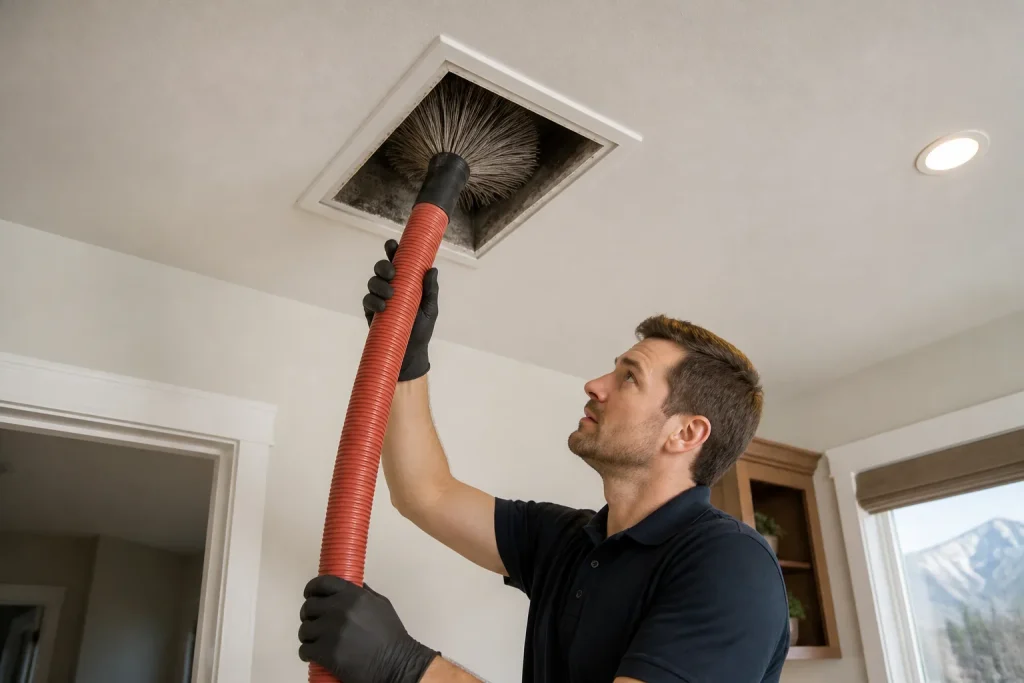
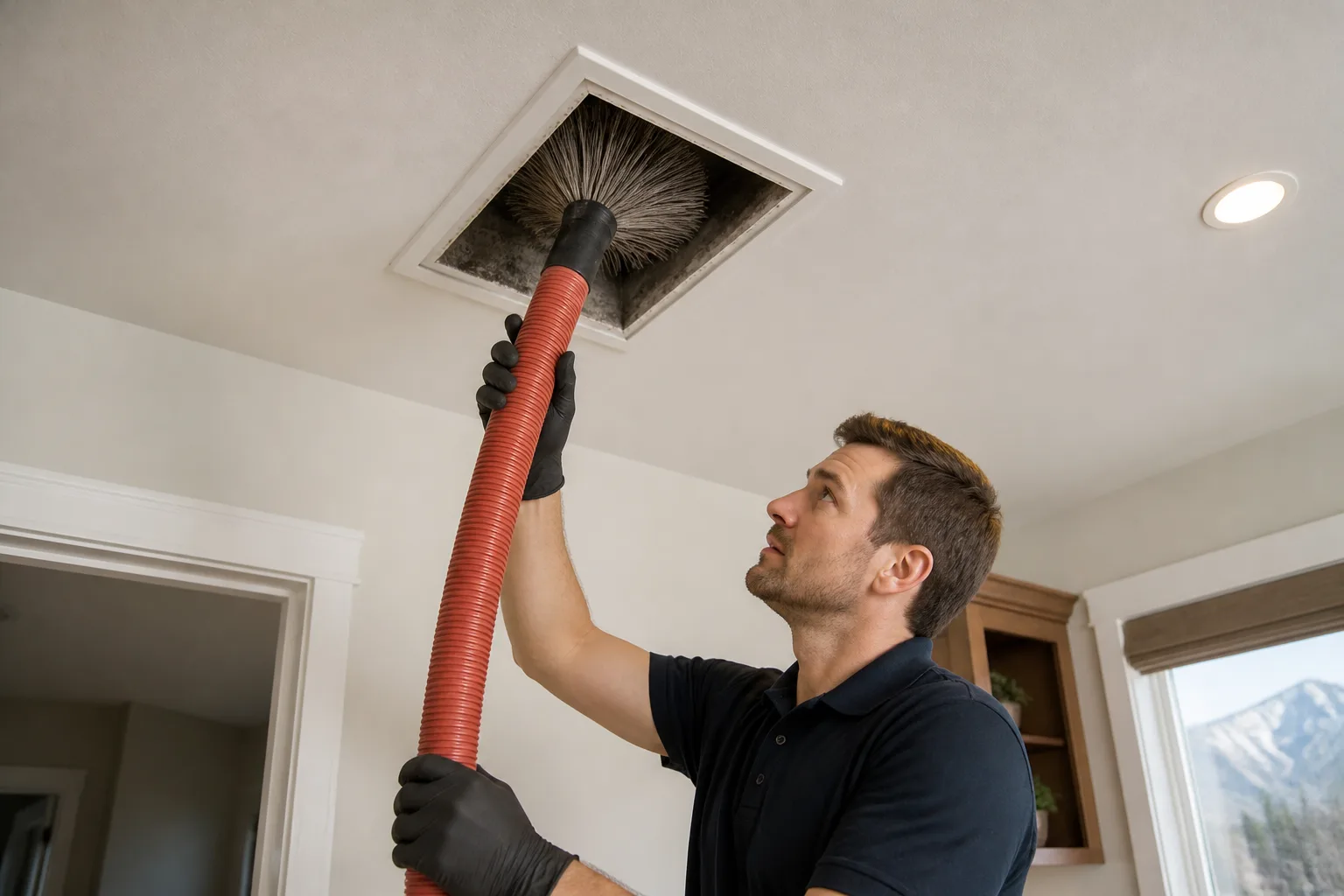
Any dust or soot that gets dislodged during cleaning has to go somewhere. A HEPA-filtered negative-pressure machine is connected to the duct system and pulls air out of the house, keeping contaminants from blowing back into your living space. The equipment we specify, like Rotobrush and Nikro contact-vacuum systems, is purpose-built for this. Abatement Technologies air-filtration units are deployed on-site to capture particulates at the source. This is the step discount crews skip, and it’s the one that determines whether your emergency gets resolved or simply redistributed.
3. Containment, cleaning, then sanitizing
Once negative pressure is established, the technician cleans the full run, then applies a sanitizing treatment rated for HVAC environments. Guardsman-line products are what we use for that step. Sanitizing here is a formal part of the response, not an upsell tacked onto the invoice.
If a company’s emergency response is “we’ll be there in an hour with a vacuum,” ask them the two questions in the section below before you agree.
Salt Lake City Air Quality Events That Mimic a Duct Emergency
Salt Lake City sits in a valley, and that geography does two things to indoor air quality. During wildfire season, smoke settles into the valley and gets pulled into return air. During winter inversions, a layer of cold air traps pollution close to the ground for days. Both can make your ducts feel like they need emergency attention when they mostly need good filtration and a scheduled cleaning.
Here’s the difference: an air quality event produces a general haze, a faint smoke smell, or irritation that clears when you leave the house. A duct contamination event produces an odor that follows you from room to room, visible dust on registers, or a smell that’s present even with the windows closed and no outside smoke. If it’s the first, running your HVAC with a high-MERV filter and keeping windows shut during an inversion is the right move. If it’s the second, the ductwork is the problem.
We see the distinction matter most in the winter, when an inversion coincides with a dusty house and homeowners assume the ducts are contaminated. Often the real answer is a full air duct cleaning on a scheduled basis rather than an emergency response. We can look at both scenarios and tell you honestly which one you’re in.
The Two Questions to Ask Any Company Claiming Emergency Availability
Not every company that advertises “emergency air duct cleaning” has the equipment to do it safely. Two questions filter out most of the ones that don’t.
Question 1: “What negative-pressure equipment will you bring?”
Listen for a brand or a type. Rotobrush, Nikro, Abatement Technologies, or a HEPA-filtered negative-pressure machine. If the answer is “a shop vac” or “a big vacuum,” they don’t have the tools to contain what they’re about to loosen. Walking away is the right decision.
Question 2: “Will you run an inspection camera before cleaning, and give me the footage?”
A company that inspects first can tell you the source and scope. A company that skips inspection is guessing, and guessing on a sewage or soot problem can make it worse. The footage is also your proof the work happened, which matters if the problem returns.
We answer both questions with specifics, and we’re happy to be compared on the answers. If another company’s response to those questions is vague, that’s your signal.
When to Call a Pro
Call a professional immediately if any of these are true: you smell sewage coming from a register, you’ve had a fire (even a small one) anywhere in the home, you’ve seen a rodent inside the ductwork, or visible mold is spreading along the duct interior. Don’t run the system in the meantime. Call (855) 658-4198. We answer 24/7. Fast dispatch from 7am to 7pm, Sunday through Friday, and a technician can walk you through the shutdown over the phone while a truck is on the way.
Related services in Salt Lake City: HVAC cleaning covers the air handler and coil alongside the ducts, which matters after a fire or a heavy smoke event. dryer vent cleaning is a separate safety item worth scheduling if it’s been a while. And our Salt Lake City Air Duct Cleaning Co page covers the full scope of what we do.
The Bottom Line
The sequence that matters in an emergency duct situation is simple: shut down the air handler at the breaker, not just the thermostat; don’t run the system to “clear the smell”; and hire a company that runs an inspection camera and negative-pressure isolation before any cleaning starts. Everything else is detail.
If you’re in Salt Lake City and need help, Salt Lake City Air Duct Cleaning Co offers free estimates. Call (855) 658-4198. We answer 24/7. Fast dispatch from 7am to 7pm, Sunday through Friday. The local pro is licensed and insured as their state requires, the price is set per job by a written estimate agreed before work starts, and you get before-and-after photos of your own ducts. That’s a simpler answer than hoping the smell fades.
Written by the team at Salt Lake City Air Duct Cleaning Co.
Frequently Asked Questions
Emergency cleaning is priced per job by a written estimate, not by a coupon or a per-vent rate. The range depends on how many runs are affected, whether negative-pressure isolation is needed, and whether sanitizing is part of the response. Estimates are free. Call (855) 658-4198 for an exact quote.
No. Running the blower pushes contamination into every room the system serves. Shut off the thermostat, then find the breaker for the air handler and switch it off. If you’re not comfortable opening the panel, call us – we’d rather talk you through the shutdown than have you guess.
Ask for inspection camera footage before and after cleaning. A company that runs a camera on arrival has documentation. A company that doesn’t has a claim. We provide before-and-after photos of your own ducts for every job, and the footage tells you whether the problem is resolved or just hidden.
Usually not. Smoke settling into the Salt Lake City valley during fire season often clears with windows shut, a high-MERV filter, and normal system operation. A duct problem shows up as persistent odor, visible dust at registers, or contamination the camera can see. If you’re not sure which one you have, call (855) 658-4198 and we’ll tell you honestly whether you need a cleaning or just a filter change.
Need Air Duct Cleaning Help?
Call Salt Lake City Air Duct Cleaning Co - the local pro we connect you with is licensed and insured, with free written estimates in Salt Lake City.
(855) 658-4198